Showing posts with label research. Show all posts

Wednesday, May 15, 2013

Gene Linkage

I have to admit that I had forgotten all about gene linkage from my high school/college days until I read Candy Haenzel's genetics booklet last year. I originally ordered it because it had a great chart for Angora rabbit folks (like me) who were confused about the different color names and genotypes of Angora rabbits. I use it as a reference for all my color work now as I feel Candy is the foremost expert on Angora rabbit genetics... BUT, my favorite part of her booklet was actually the chapter on Linkage. 

I have a black buck that carries shaded. His genotype is aaBbCc^chlDdEe. He has produced several pearls and sable kits, all of them chocolate based. 

According to the rules of linkage, genes that are linked will remained linked about 65% of the time. In rabbits, the B and C loci are linked. So...I hypothesized that my black buck's b is linked to the shaded gene (c^chl) since the shadeds he produces have all been chocolate (bb) based.    

One of this buck's offspring was also black. I kept him and wondered if my hypothesis was correct. If it was, this young black buck would probably not carry shaded as his mother (a chocolate doe) would not have a B to contribute. His B would have to come from his father. Since the father's b was linked to his shaded gene, it would follow that the father's B was linked to his C.

I bred this younger buck to a REW doe because I felt they would be a nice pairing with the added benefit of seeing if the buck carried shaded.  

Did I get REW or shaded kits so my hypothesis could be easily confirmed? Nope. I got 3 black kits and one lilac tortoiseshell. The buck could be CC. I hadn't planned on breeding him again as I have a better potential herd sire now, but I admit that it is tempting just to see if I was right


Wednesday, May 8, 2013

Pasteurella Vaccine Info Video

Every week my friend, Lil, and I do a Google+ Hangout. We always meet and usually broadcast these HOAs on Youtube. This week we had the pleasure of meeting Mr. Bob Glass. He caused quite the commotion this week by introducing a pasteurella vaccine for rabbits.  I talked to Mr. Glass at a rabbit show in Austin, TX this past weekend. Lil and I were super interested in finding out more.He was kind enough to answer questions from Lil and me. I mostly just asked Dr. Mina's questions as he was kind enough to help us out with pertinent questions. Anyhow, it was quite a learning experience.  Here's the video from our informal Hangout.

Thursday, April 18, 2013

KW Cages Rabbitech System Review

I've had my Rabbitech system for about 7 months now. I thought it was time to post a little review about my system.

As far as looks go, it is big, shiny, white and medical lab looking (a bit out of place in my old garage), but I love my Rabbitech system. It is very professional looking and sure beats dumping drop pans. There is still work involved maintenance wise though(contrary to popular belief lol)...just different work. Instead of running around dumping pans, I stand and wipe down things. I pull down and replace panels. I spray waste down a trough. I dump the manure/urine collector and hose it down. It's not too bad, but some areas are a bit tricky to get into. I often scrape my knuckles on wire, but I have rabbits. Everyone does that.

I have not had a problem with clogging hay as I saw on some reviews of these types of systems, but hay does slow down the spraying down of troughs. Overall, I think it is very well designed. The back panels and side trays do a very good job of keeping urine inside the system and not on the walls/floors. I can easily scrub cages (floor tops and bottoms) when the back panels are removed. The finish is very durable. I have had no issues with rust or chipping. There was definitely thought put into it.
If I were to make improvements, I'd suggest the following:

  • a quicker/easier way to take off back panels for cleaning (arthritis-y hands). Otherwise, I love, love, love the back panels...such a simple, but functional feature. 
  • slightly more space between cage front bottom edge and trough top edge. I could get cleaning tools in there easier without scraping hands.
  • The PVC spray-down troughs are great, but finding tools to clean it at first was a challenge since you must use nonabrasive tools.  After several other tries, I now use a stoneware pan scraper from Pampered Chef...probably not what PC originally intended. This helps keep the trough smooth so pellets roll down the trough as intended. An automatic rinse system for the trough would probably be helpful (less chance for urine to dry), but I haven't tried this yet. I worry about damp wool on my Angoras. I do
  • a better set of instructions for non-laboratory maintenance department professionals. Instructions were sketchy. In their defense, though...the system is probably sold to a smaller percentage of regular folks with rabbitries. We did eventually get everything together without calling customer service...and I admit that I may be challenged in this area.
 

This is not a design issue, but something to be aware of. We purchased the manure separator bin (an accessory). We attached our garden hose as designed, but the lay of our land meant flow was so slow to render it useless. I have to hand-carry and dump liquid waste...blah. The manure separator seems like a wonderful thing when the system is higher than the surrounding ground though.  

Also, I put my one-sided system together as the directions indicated. Once it was all balanced and silicone-ed in place, I realized I had to move my system out from the wall about 18 inches to get behind and clean it. In talking to others, someone much smarter than me told me they turned their troughs where the manure slid to the front of the cage instead of the back. This doesn't look as pretty in my opinion, but it does save space in a smaller rabbitry. I'm probably just jealous that I didn't think of it myself. 

Tuesday, January 15, 2013

Sherwood Forest Natural Rabbit Food Progress

It's been a while since I posted about my Sherwood Forest Natural Rabbit Food progress.  I have now converted almost all of my herd to the feed.  I've been trying to stay on their program so I can see exactly how their feed performs. 

NOTE: My main focus is show/fiber herd and smart breeding decisions. This feed experimentation is my little side project so I have not increased my breeding plans. Therefore, I may not have good numbers until much later. 
 
Pregnant does were on the Pregnant Rabbit Feed. I had my first SHNRF doe kindle with no problems in December. As per the program, I converted the doe to the lactating/growth formula (L/G) once the babies arrived.  I really liked that she did not loose condition like some of mine had previously done on other feeds.   Often, I added supplements to the diet to help keep weight on the lactating doe. This time, I added nothing, just free feeding the L/G formula. However, a sample set of 1 is not very conclusive. I am excited to see how the numbers develop as things progress.

This first litter is now on the L/G formula.  They are eating on their own quite well now. They had no problems transitioning from mother's milk. They will continue to be on the L/G formula until about 12 weeks.  All rabbits from this litter will be my show herd, so they will be with me for awhile for observation.

I'm very excited to see how their coat develops on this feed. The consensus is that Angoras need a 17-18% protein feed to grow a large show coat.  The Sherwood Forest Natural Rabbit Feed L/G formula is 15% crude protein and the adult rabbit formula (which they will receive after they are 12 weeks old) is 14% crude protein.  

This seems like not enough protein to grow a nice coat. However, because the protein is of better quality...My non-show/retired adult rabbits have continued to develop their dense coats. There has been no difference in wool production between my former 17% protein feeding regime and the Sherwood Forest Natural Rabbit Feed. 

These new babies will my first show litter raised entirely on the Sherwood Forest Feed. I have been very pleased with how they are doing so far. It will be interesting to see how they develop.    
 

Friday, December 14, 2012

Google + Rabbit Communities

I spend a lot of time on Facebook...however, not so much to keep up with family and friends anymore.  I am usually on the Facebook rabbit groups.  While these groups can be super dramatic, they can also be an interactive resource of information if used properly.  I've really learned a lot from discussions on these groups.  

Facebook groups are great, but Facebook isn't the only way to communicate with rabbit people.  The new Google + Community pages (released December 6th) also does all the great things Facebook does, but it allows topics to be searchable...which Facebook does not.

I know that the last thing some folks need is yet another social network to keep track of, but it's really not bad if the Google+ application is downloaded to your phone or computer. You can get (or turn off) notifications just like Facebook.  Most rabbit social media folks are on Facebook, but I think the Google+ communities will provide an additional way for rabbit people to communicate with the added bonus of indexed content...no more scrolling through a zillion old posts to find that one post about nestbox management

Above is a video about Google communities and below are a couple of links to rabbit communities. Enjoy!

Google+ Rabbit Breeders Community
Google+ Angora Rabbits Community 


Tuesday, October 9, 2012

Litter Box Adventures - Part Deux


Continuing with the litter box theme...We also tried what we dubbed the "Sterilite Special". 

It is a modified Sterilite plastic storage bin.  This worked pretty well for our messier bucks.  It was definitely cheap...$1.25 spent on black plastic door guard trim.   

We simply used an old plastic container we had and the plastic door guard trim.  We started by drawing our door onto the container using a sharpie marker.  We then drilled a hole through the plastic (and inside the door we drew) so a jigsaw blade could fit in. We then used the jig saw to cut out the door. 

WARNING: Be very careful if you try doing this.  Wear safety glasses and watch hands/fingers.  Plastic cuts  very differently than wood.  We only made one because I was chicken about the cutting.  A Dremel might work better, but ours burnt out during one of my other "ideas".  

The door guard trim went around the cut edges to keep from snagging wool.  We drilled holes through the plastic and used carabiner clips to attach the litter box to the cage.  We placed wood pellets in the bottom and put a plastic foot pad over the pellets.  

The Sterilite Special worked well at first. Then our buck decided to just use the area just outside the litter box.  He didn't seem to like the "trapped in" feeling when he was inside.  I wonder if he'd like it better if we cut out two holes in the tote.  Rabbits always seem like to have another exit so that could have been the problem.  

Saturday, October 6, 2012

Litter Box Adventures

I try to litterbox train rabbits before they go to another home.  I think this helps make owning just one or two rabbits (in a non-herd setting) much easier.  I try to set the rabbit up for success.  Most take to litterbox training very well.  This has lead to some experiments with different litter boxes as I try to balance what I like with what my pocketbook likes. Over the next few posts, I thought I would share a few of my litter box adventures.
The corner litter box with wire grate works great short term.  It is expensive, though.  I got mine for about $17 for the extra large corner litter box from a large chain pet retailer.  Sure, it's fine for one or two, but not a practical purchase for a herd.  

One of the problems with this type of litter box is that rabbits like to chew on the removable lip that comes with the litter box.  I don't know why the manufacturer even bothered to put it on.  I (or the rabbit) took all of them off of my litter boxes. 

The small wire grate is not very durable either.  I purchased several litter boxes over a period of time and most of the wire grates failed within 2 months of use.  These litter boxes do work great for kits and young juniors, though.  I usually leave these in my weaning pens.   

Also, feisty rabbits can learn to wiggle the latches that hold the litter box to the cage.  They then wear it as a hat...which is very entertaining to them and to me, but does not allow the litter box to serve its purpose, plus it is no fun to get pine pellets out of wool. I think this litter box is the prettiest though out of the ones I've tried.

Tuesday, October 2, 2012

American Dwarf Hotot Rabbit Club Membership

I recently joined the ADHRC because...well, among other reasons, dwarf hotots are so stinkin' cute.  I have been looking at them...thanks, DH blog friends...for some time now.  I eventually will add another breed to my project...like within the next year or so.  I wanted the second breed to be a regular haired rabbit, but one that would be challenging enough for me to stay interested (but hopefully not frustrated).  Of course, it had to be visually appealing as well.  I think dwarf hotots fit the bill.

The ADHRC seemed like a great place to start.  For a $10 membership, I got a great guide book, pamphlets, and general information about dwarf hotot rabbit breeders in my area.  I think that's a pretty good deal! I have already read the guide book from cover to cover.  There was lots of interesting information regarding DH genetics.  I'm learning a lot already. 

Tuesday, September 18, 2012

My Yard Is Green...with Dandelion Leaves

Thanks to the much cooler weather, rain, and my lax front yard maintenance schedule, the dandelions are all abloom in my yard. Thankfully, my neighbors do not seem to mind.  I do not mind either; dandelions are my favorite flower.  They are so useful.

Every morning you can find me outside with a bowl picking the day's crop of greens.  It's the best kind of vegetable garden, growing with absolutely no meddling from me. To be honest, I would probably mess it up anyway.

Dandelion leaves have long been known to be good for rabbits.  My rabbits go crazy for them. Feeding greens is a part of my anti-woolblock regime. 

Most of the information I could find about dandelions refers to human consumption, but it probably isn't too far off base for rabbits either. Here are some interesting facts about the little dandelion leaf.
  •  Dandelions rank in the top 4 green vegetables in overall nutritional value.  
  • Dandelions leaves are a diuretic. I did not know this, but find it interesting. 
  • The dandelion's scientific name, Taraxacum officinalis, means disorder remedy of pharmaceutical value 
  •  There is a website out there totally devoted to dandelions, http://mydandelionisaflower.org
The rabbits really enjoy their treat and I get a bit of exercise. 

Sources:
 USDA Bulletin #8, "Composition of Foods" (Haytowitz and Matthews 1984)

 Clare BA, Conroy RS, Spelman K. The diuretic effect in human subjects of an extract of Taraxacum officinale folium over a single day. J Altern Complement Med. 2009 Aug;15(8):929-34.

Saturday, September 15, 2012

Sherwood Forest Natural Rabbit Food Trial (UPDATED)

Sherwood Forest NRF(top), my feed(bottom)


Sherwood Forest Natural Rabbit Food has been on my radar for a bit, but I just recently bit the bullet and ordered a free sample of their food.  I've read all the promotional material.  It sounded good, but why wouldn't it? It's their material. 

But, I'm super attracted by all the science-y talk and the research involved.  Sure, all the feed companies have research departments.  It's just not all out there on the company's web page. I like that.

Someone on one of the many Facebook groups, online forums, or Yahoo! groups I belonged to one gave an excellent description of what a good rabbit food should look like and what to look for on the ingredients list. I wish I would have copied the exact posting because it is what I use now as my guide to rabbit feed.  My wording is not near as good as the poster's.

This feed passed all the initial tests.  It was super green and smelled great.  All...and I mean, all of the rabbits jumped to attention the moment I opened the small plastic trial bag.  They do not usually do this. I would see actual chunks of alfalfa in the pellet.  The ingredients list contained words I could actually pronounce.  Two of my rabbits volunteered to be "guinea pigs".  I will try them on this feed and see how it goes.  While not exactly a scientific trial, I am excited to see how it goes.

What I'm worried about:
  • Protein %.  My Angoras need lots of protein to grow wool...or at least that's what I've read.  After several emails about the quality of protein with Sherwood Forest Natural Rabbit Feed, I was willing to give it a try with some of my non show herd rabbits. I actually LOVE my current feed.  I'm just curious mainly...and always looking for improvement. Although recent freshness issues have made my curiosity go into action.
  • Corn. My current feed is a corn free feed. I've read most of the research quoted on the Sherwood Forest NRF Web site.  I'll buy that corn is not better or worse than wheat or barley.  I read somewhere that sunflower meal is actually better, but I haven't seen a feed that uses it.  
GUESS WHAT!  Sherwood Forest Natural Rabbit Feed has NO CORN in it!  Whew, one less thing to worry about. Although, really I'm not scared of corn...just of change lol.   
 
We're on day 5 of our feed trial.  So far, the rabbits have transitioned well and love the feed as much as their old feed...no problems with diarrhea or loose stools.  I ordered a bigger box.  Nope, it's not cheaper than my old feed, but I think, just like the rabbits, I'm hooked on the smell.            

Wednesday, August 22, 2012

Local Rabbit Club Meeting About Cavies

One thing I really like about our local all-breed rabbit club is that each month we learn a little something new. Kudos to those folks who plan each month's presentation, game, or activity. 

Last night we attended our monthly local rabbit club meeting and learned a bit more about cavies.  ARBA Judge Michael Franke gave an excellent presentation, teaching youth and adults about cavy body type, fur, and general care.  Right now, our activities are geared towards preparing our youth for Convention.  

Here are some things that I didn't know about guinea pigs.
  •  Four toes on the front feet....only three on the back. 
  • How much I liked the Abyssinian breed.  DH shook his head "no" from the back of the room.  
  • Roan is a white intermingled with another color...and my favorite color variety.  
  • They are only allowed two teats; anything more or less is a DQ...but they can raise 3 or 4 babies easily with no problem.    
  • Cavies become sexually mature at 3 weeks...so separate at weaning.  
  • After a 70 day gestation period, they are born with fur and eyes open...similar in development to a six week old rabbit. 
By the end of the presentation and  hands on piggie time, most of the kids were begging for a cavy.  I have to admit that I really wanted one too. 

Next month's activity....Bunny Bingo.  I can hardly wait! 


Sunday, July 22, 2012

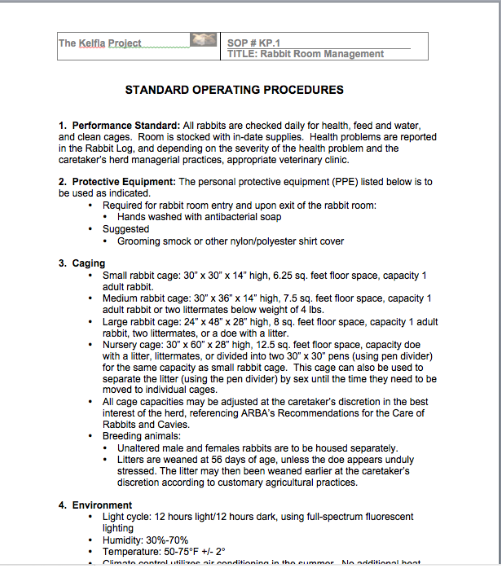
Making My Own Standard Operating Procedure

With ARBA's recent Recommendations for the Care of Rabbits and Cavies, came the suggestion to create our own SOP for our rabbit herds.   So what is an SOP?  Well, it can mean many things to many people and I decided to do a little research about this. Being a former soldier, I was very familiar with Army SOPs. The military revolves around these things, which are usually called Standing Operating Procedures. They end up meaning almost the same thing...a written guide to what you're supposed to do and how you're supposed to do it. 

Although I did not have an official herd management SOP, I have always kept a Rabbit Log where I jotted down notes about each rabbit as I went through my daily chores.  This comes from my days as an animal care technician.  We had SOPs at the animal lab, too.  They were huge books that spelled out how to do everything from clean a cage to emergency evacuations...so scientific animal laboratories were where I went to find my SOP models.

After checking out quite a few complex standards, I found a simpler SOP that fit my needs. I was not trying to write War and Peace. I don't have time for that. I was just trying to find a short document that filled my needs and hit on major herd care points.  The nice thing was that I could write my SOP to meet my particular herd needs. I can make revisions later, too...if what I originally documented does not work or my herd's needs change.

I have a copy of my draft SOP here. You are welcome to use it to adapt for your own rabbit herd management. Since we all keep rabbits in our own way, please adopt for your own circumstances and practices.  Also, if I left out something important, please let me know. It's a work in progress.

  Thanks to my source for a simple SOP - the Frederick National Lab for Cancer Research at Fort Detrick, Maryland.
  

Monday, July 16, 2012

TARC Webinar was fun...and a success!

Technology is wonderful! I'm so excited about being able to communicate with folks around our state (and beyond). I really enjoyed our first webinar and, to be honest, I wasn't sure how everything would go off.  I knew we were working hard, but sometimes you just don't know if things will pan out the way you envisioned.  

We had 9 attendees from all over Texas and Louisiana who were engaged, asking questions, and learning. Sasha put on an excellent presentation with help from her bunny models, Candy and FooFoo.  There was time to discuss things that we never get a chance to discuss at a show, or even when just visitng. The whole thing went without any major glitches and I'm sure that everyone got something out of it (including me).   Our attendees asked excellent questions and even gave some good, supportive advice too.  I have to say that our first webinar was a success!


The Texas Angora Rabbit Club hopes to expand our webinars as part of our plan to educate others in our state about our favorite rabbits...Angoras.  


Wednesday, February 15, 2012

My Animal Manager Application

My Animal Manager Control Panel
Just wanted to share an animal management system that is a little bit different from the more familiar Evans, Breeder's Assistant and Kintraks...

Homestead Apps released an app to help hobby and urban farmers manage their animals - My Animal Manager.

Monthly Summary..note the solid row of zeros
in the income section.
My Animal Manager is a management system that helps you organize record keeping for all of your animals...including rabbits.  You can separate finances by animal type, keep show records, medical, feed, production, pedigrees, breeding records and month by month comparisons for last 3 years...alot of the standard stuff.  The thing that makes My Animal Manager a bit different from other systems is that it is a SaaS product.  Software as a Service (SaaS) means that your data is online ...kept secure by encryption...and accessible from any device with internet access.  Think Cloud computing.  This allows me to log in and enter information right from the rabbit's cage instead of "remembering" or "jotting down notes" for input at a later time.  There is no download or installation necessary. No worries about my own computer crashing and losing data.  Everything is up in the "Cloud." Updates are automatic and free.  Sounds interesting, huh?  I thought so too...so I tried it.  So far, it's pretty good and useful for bunny applications.  
Individual animal record example

Here's what I found:
PROS: 

  • I could enter multiple animal species.  It's nice to have all the critter's stuff in one area...which allowed me to totally gloat that my bunnies haven't cost near as much as our daschund mix's outrageous (and thus far, partially successful) dog training classes.  Crazy dog!
  • For the most part animal entry is pretty intuitive. It was easy to figure out.  The only exception was pedigree information.  I couldn't find it.  However, I just clicked on online help and someone promptly responded with how to get to the pedigree part and how to enter sires, dams, etc.  Good service was another plus.
  • There are cool charts for all kinds of stuff...like meat, egg, and fiber production, including withdrawal dates for meat and egg producers.  I find this part particularly useful for my Angoras.  I am able to record how many ounces of fiber I harvest from each animal very easily.  And of course, looking at the blank egg production section made me want to add chickens to our menagerie.     
  • There is a section to record buck breeding info as well as doe breeding info.  I can keep track of how "potent" those boy bunnies are.  There is also a pregnancy report...and of course breeding records.  
  • You can track feed usage per animal, or per species.  Medical treatments records are available as well as a section for veterinarian visits, if necessary.  
  • The main panel current year summary report is like a little dashboard controller that gives you an overview to all your info. I haven't entered all my last year totals(receipts) yet, but it will be nice to have a comparison.  
CONS:

  • My Animal Manager is $14.95 for a ONE-YEAR subscription.  It's written pretty plain, but since I'm used to seeing "app" and thinking "just buy once", my bad. Still, though, it's pretty cheap to get started. Yippee!! I haven't really done the math on this one, but something tells me that it might add up if you use it a while.  Keep in mind, though, updates are free, so maybe not so much of a con.   I also didn't see a place to export or import data...so must enter it manually at first. Yuck, if you've got lots of buns.
  • Pedigree info grand champion fields are only about three characters long.  I have grand champion numbers in some pedigrees that are six digits...so they don't fit.  Boo.  I just used an empty field that said ID number and adjusted it to read GCH#.  That showed up on the pedigree just fine.  By the way, pedigrees themselves are plain jane, but have all the ARBA necessary stuff, like weight, registration #(right ID), tattoo# (left ID), and weight.  
  • No genetics info.  Although fun to play with, I'm not too upset about that.  I like to figure out genetics the old fashioned way and there's always online genetics calculators to check my work.  Just make sure they are reliable. However, it would be nice to have some inbreeding coefficent info.  
  • No show entry forms.  That would be super handy.
  • If you want to track feed usage AND feed expenses, you have to enter it twice...once in the feed screen and once in the expenses screen.  What's up with that?  I see that they are constantly updating, so I hope that they will adjust that soon.  Hasn't been too much of a hassle yet, though.  
Everyone I know compares everything to Evans.  Evans, it is not...yet.  Evans is definitely a more robust product...with a more robust price. My Animal Manager is another option if you need to keep electronic records at a more affordable entry price...and you want chickens, too.  http://homesteadapps.com/

Tuesday, January 24, 2012

More Scientific Research Tidbits

Completely unrelated, but cute :)
Fall semester has started again and I'm in an academic kind of mood...so I thought I would pull out the ole' Recent Advances in Rabbit Science and see what else I could find.  Same rule applies as last time, my friend: I will put the page number as a reference in parenthesis. Please note that the page number refers to the page of the pdf file, not the page number on the document.  They are different in some cases.
  •  Scientists have done a lot of studies about rabbit housing...mostly in regards to stocking density, cage size, and group pens.  Most of this research has been done due to the public's desire for a high level of animal welfare in meat production in European countries.  The journal covers five different situations: 
    • Single caged rabbits - Provide breeders with higher productivity with better disease control and mortality. It also avoids the risk for aggressive behavior. However, a lack of social contact among animals may cause stress and public perception is poor (130).
    • Stocking density - Rabbits (particularly 3 to 6 week early weaned rabbits) preferred to stay clumped together in a higher density cage.  Again, duh?  BUT, even after weaning, research results show that rabbits tend to group together at a higher density instead of opting for better living conditions (131).  
    • Group size in cage -  Performance in small cages (2-3 animals) and large cages (6-8 animals) were compared.  Group size was not found to affect weight gain, body weight, feed intake or mortality. As long as group size was lower than recommended, it had no affect on producivity or dress out percentage (for meat animals). The amount of peri-renal fat decreased with the increasing number of rabbits per cage (Don't know about rabbits, but peri-renal fat is an independent indicator of kidney issues in humans. Someone please chime in if you know.). However, percentage of ear lesions and serious injuries on the animals increased as group size increased (132).  
    • Stocking density in pens - Had only a slight effect on the production of rabbits. Mortality rate was higher on deep litter (straw-filled) than wire floors due to disease (132).  I tried to decipher their chart on the various stocking densities, but it is beyond me today.  I'll try again later. Charts are on pages 132 and 133, if you are interested. Minimum space allowances for rabbits guidelines are on page 136.  They're metric so have fun :) 
    • Cage vs. pen - When comparing performance of rabbits housed in cages or pens, floor types were discussed separately. They compared wire floors to deep litter.  There was a reduction in growth rate for penned animals that was attributed to greater physical activity and/or lower feed intake. Mortality rate was higher in pens due to contamination with excrement and consumption of soiled litter. Rabbits rested less while housed in pens which is generally said to be an expression of good welfare. However...again, frequency of ear lesions was higher in pen housed rabbits.  BUT, these aggressive incidences can be reduced by simply inserting a gnawing stick into the cage/pen. When the temperatures entered the 59 - 68 degrees Fahrenheit range, rabbits prefer staying on wire netting instead of deep litter. The decrease of production of growing rabbits is 3-4 times worse on deep litter compared to wire floors (134).
Overall, the journal recommends rearing rabbits in pens with wire floors at a moderate density (a whole litter together until sexual maturity) and using wooden sticks to reduce body lesions as an alternative housing system.

So what does all this mean to the hobby breeder?  I look to balance what these reports say with my own needs and facilities.  As I remodel or rethink my rabbit room, I take that info into consideration. Right now, I raise my kits in 30" x 60" wire floor pens. Perhaps I should put in a gnawing stick. It couldn't hurt and it might actually help wool-chewing. My rabbits are individually housed in wire cages. They are currently in a typical setup...all in a row, but eventually, I plan to clump the cages together in a square (does in one square; bucks in another...separate areas) so they can all see each other and hopefully increase social interaction without dealing with ear lesions or worse. My EAs are a laid back group, but they are rabbits. I choose this arrangement because wool chewing is dangerous to rabbit health (wool block) and it ruins their beautiful coat as well. I am super-fine that my rabbits live on wire floors.  It is best for their health and cleanliness...in my situation. Your mileage may vary.  I have resting pads in the cages, but my rabbits don't even use them. They prefer to rest on the wire itself. Like everything else, it's all about being open to new ideas/research and what works best for your situation.  I'm having fun. Do what works for you :)


Wednesday, January 4, 2012

Scientific Research Tidbits

The rabbit has historically been a neglected creature in the scientific research community.  Oh, yes, those little guys have been used for research for many years, but the rabbit itself had not been researched near as much.  The World Rabbit Science organization was formed (with the first World Rabbit Congress in 1976) to unite rabbit scientists around the world.  On their Web site, there is a section for online scientific research.  I love this stuff because it is as objective as information can be, regardless of your philosophy.  


I just wanted at share some interesting tidbits gathered from rabbit research around the world, resulting in a journal called "Recent Advancements in Rabbit Sciences" Edited by L. Maertens and P. Coudert.  This book was a joint effort of COST (European Cooperation in the field of Scientific and Technical Research) to consolidate fragmented, short term and discontinuous rabbit research into one area.  Fourteen countries participated. The journal is in pdf format and available to download so you can read all 309 pages at your leisure haha. NOTE: The page number where I found the information is in parenthesis.
  • Artificual insemination (AI) is widely used on European rabbit farms. This required the use of hormones to keep all does on the same breeding cycle.  Recent regulations have forced European rabbit farms to look at nonhormonal methods to improve reproductive performance.  Here is what  researchers have found: 
    • Scientists have discovered that cage changing, or doe gathering, before insemination has not clearly been shown to increase doe receptivity.  Some studies said YES, some studies said NO.  Scientists must be able to reproduce results before they can say it works (31).
    • If you are breeding a doe with a litter, controlled nursing applied 2 or 3 days before mating (by closing access or removing nestbox) is effective.  Receptivity is best when mating occurs right after the doe nurses her kits.  Controlled nursing works best for mating receptivity if kits are completely removed from doe's area...no smell, no sight, no hear (34).  
    • The "buck effect"...placing a doe in the cage next to a buck, was not shown to increase receptivity as it does in other animals. What?! This made such sense to me so I was surprised it could not be easily proven. The "buck effect" works with other animals...with rabbits, not so much.  However, bucks in the cage next to a young doe can induce sexual maturity and receptivity in those young does...not in older does, though (41-42)...so all is not lost.   
  • Investigations show that does prefer to jump on an elevated seat if possible.  A second floor is used by does as a withdrawal area from pesky kits.  The floor material of second floor is important to consider because solid surfaces (such as wood) can carry risk of endoparasite infection (81) and slots can get manure and urine on kits below. 
  • In the last few days before kits are born, their nostrils open up and they can smell the food that has passed through the placenta from the mother's diet .  If a kit is born to a doe fed parsley during gestation, they will be naturally drawn to parsley odors after birth.  This preference continues through weaning, with kits displaying a preference towards the foods the doe has eaten(88-89).  How cool.  
  • Controlled nursing (removing nestbox from mother's cage and replacing on a time schedule) kits remained in the fear freeze stance for less time than free-nursed kits in experiments. These kits also had a higher growth rate and a higher degree of relaxation.  I am jealous of these kits and their higher degree of relaxation.  
  • Kits are highly senstive to people handling them in the first period of life so it is important to handle them.  This lowers their stress reaction due to the 'fear' of humans after weaning (93).  A higher tolerance to stress means stronger immune systems. It's a win-win.  
  • These handled kit's reduced fear is long lasting and specific to the handler species. If you want your kits to be people friendly, handle them when you take them over to mama for nursing. These handled kits later showed higher conception rates when mature than non handled ones, too.  The optimal window for handling kits for reduced fearfulness is 15 minutes before and 30 minutes after nursing during the first week of life(103-104).  These little guys connect us to happy, feel good nursing activities. Kits handled like this are said to be 70% more bold, making better people rabbits...if you raise fancy breeds.  
  • During a group housing experiment, it was found that solid floors are not recommended due to urine and dropping contamination, causing disease. Floors should be perforated.  Alternative floors such as plastic slats (baby pig slats/MIK flooring) experienced more sore foot lesions(113). The use of footrests on wire netting floors is recommended to provide a comfortable resting area and void footpad injuries(116, 119).  Wire netting walls are also recommended to allow individually housed rabbit does to have social (visual) contact with their neighbors(117, 119). 
  • Research has found that a combined method of controlled and free nursing is best when raising kits.  Free nursing during the first week of life and controlled method afterwards.  Milk production of does was not affected by the nursing method.  There were differences though, if mom was a first timer. First time mothers and litters benefited from controlled nursing with lower mortality rates.  However, experienced mothers did better with free nursing (119).  The combined method is a good compromise.  
  • Cages  (size, equipment, etc.) used in rabbitries are suitable for production and also that they have no harmful effects on welfare (119).  There it is...in writing...in a scientific journal. 
  • HOWEVER, The addition of a wooden stick, or other environmental enrichment, in rabbit cages had a positive effect on rabbit productive traits, behavior, carcass and meat characteristics.  AND such enrichment is a good way to improve public image of intensive breeding programs (125).  
This is just the tip of the iceberg of cool info.  Maybe it's worth an additional post. But don't take my word for it...check it out here.
Related Posts Plugin for WordPress, Blogger...javascript:void(0)