Showing posts with label manuals. Show all posts

Monday, July 30, 2012

Betty Has Even More Great Angora Tips

Inside the latest issue of Domestic Rabbit is an informative article about judging English Angora rabbits written by Betty Chu. 

She follows up with the Northern California Angora Guild blog post where Betty gives even more insight into judging EAs.  

Each article serves as an excellent stand alone piece.  However, both read together give an even more rounded view of judging these beautiful rabbits.  

I even learned a little more Angora-ese! 

Check out Betty's NCAG post here.  

Sunday, July 22, 2012

Making My Own Standard Operating Procedure

With ARBA's recent Recommendations for the Care of Rabbits and Cavies, came the suggestion to create our own SOP for our rabbit herds.   So what is an SOP?  Well, it can mean many things to many people and I decided to do a little research about this. Being a former soldier, I was very familiar with Army SOPs. The military revolves around these things, which are usually called Standing Operating Procedures. They end up meaning almost the same thing...a written guide to what you're supposed to do and how you're supposed to do it. 

Although I did not have an official herd management SOP, I have always kept a Rabbit Log where I jotted down notes about each rabbit as I went through my daily chores.  This comes from my days as an animal care technician.  We had SOPs at the animal lab, too.  They were huge books that spelled out how to do everything from clean a cage to emergency evacuations...so scientific animal laboratories were where I went to find my SOP models.

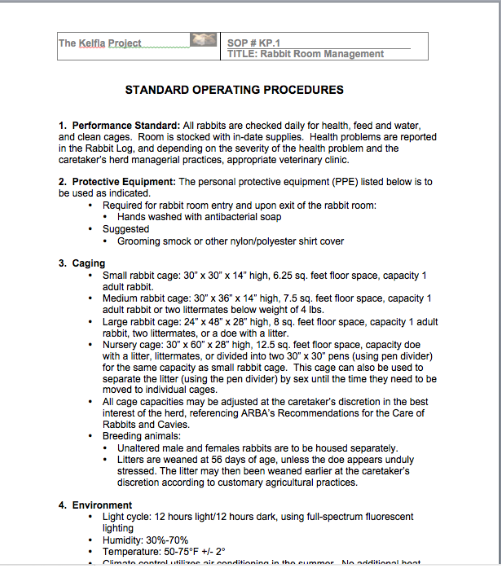
After checking out quite a few complex standards, I found a simpler SOP that fit my needs. I was not trying to write War and Peace. I don't have time for that. I was just trying to find a short document that filled my needs and hit on major herd care points.  The nice thing was that I could write my SOP to meet my particular herd needs. I can make revisions later, too...if what I originally documented does not work or my herd's needs change.

I have a copy of my draft SOP here. You are welcome to use it to adapt for your own rabbit herd management. Since we all keep rabbits in our own way, please adopt for your own circumstances and practices.  Also, if I left out something important, please let me know. It's a work in progress.

  Thanks to my source for a simple SOP - the Frederick National Lab for Cancer Research at Fort Detrick, Maryland.
  

Tuesday, January 24, 2012

More Scientific Research Tidbits

Completely unrelated, but cute :)
Fall semester has started again and I'm in an academic kind of mood...so I thought I would pull out the ole' Recent Advances in Rabbit Science and see what else I could find.  Same rule applies as last time, my friend: I will put the page number as a reference in parenthesis. Please note that the page number refers to the page of the pdf file, not the page number on the document.  They are different in some cases.
  •  Scientists have done a lot of studies about rabbit housing...mostly in regards to stocking density, cage size, and group pens.  Most of this research has been done due to the public's desire for a high level of animal welfare in meat production in European countries.  The journal covers five different situations: 
    • Single caged rabbits - Provide breeders with higher productivity with better disease control and mortality. It also avoids the risk for aggressive behavior. However, a lack of social contact among animals may cause stress and public perception is poor (130).
    • Stocking density - Rabbits (particularly 3 to 6 week early weaned rabbits) preferred to stay clumped together in a higher density cage.  Again, duh?  BUT, even after weaning, research results show that rabbits tend to group together at a higher density instead of opting for better living conditions (131).  
    • Group size in cage -  Performance in small cages (2-3 animals) and large cages (6-8 animals) were compared.  Group size was not found to affect weight gain, body weight, feed intake or mortality. As long as group size was lower than recommended, it had no affect on producivity or dress out percentage (for meat animals). The amount of peri-renal fat decreased with the increasing number of rabbits per cage (Don't know about rabbits, but peri-renal fat is an independent indicator of kidney issues in humans. Someone please chime in if you know.). However, percentage of ear lesions and serious injuries on the animals increased as group size increased (132).  
    • Stocking density in pens - Had only a slight effect on the production of rabbits. Mortality rate was higher on deep litter (straw-filled) than wire floors due to disease (132).  I tried to decipher their chart on the various stocking densities, but it is beyond me today.  I'll try again later. Charts are on pages 132 and 133, if you are interested. Minimum space allowances for rabbits guidelines are on page 136.  They're metric so have fun :) 
    • Cage vs. pen - When comparing performance of rabbits housed in cages or pens, floor types were discussed separately. They compared wire floors to deep litter.  There was a reduction in growth rate for penned animals that was attributed to greater physical activity and/or lower feed intake. Mortality rate was higher in pens due to contamination with excrement and consumption of soiled litter. Rabbits rested less while housed in pens which is generally said to be an expression of good welfare. However...again, frequency of ear lesions was higher in pen housed rabbits.  BUT, these aggressive incidences can be reduced by simply inserting a gnawing stick into the cage/pen. When the temperatures entered the 59 - 68 degrees Fahrenheit range, rabbits prefer staying on wire netting instead of deep litter. The decrease of production of growing rabbits is 3-4 times worse on deep litter compared to wire floors (134).
Overall, the journal recommends rearing rabbits in pens with wire floors at a moderate density (a whole litter together until sexual maturity) and using wooden sticks to reduce body lesions as an alternative housing system.

So what does all this mean to the hobby breeder?  I look to balance what these reports say with my own needs and facilities.  As I remodel or rethink my rabbit room, I take that info into consideration. Right now, I raise my kits in 30" x 60" wire floor pens. Perhaps I should put in a gnawing stick. It couldn't hurt and it might actually help wool-chewing. My rabbits are individually housed in wire cages. They are currently in a typical setup...all in a row, but eventually, I plan to clump the cages together in a square (does in one square; bucks in another...separate areas) so they can all see each other and hopefully increase social interaction without dealing with ear lesions or worse. My EAs are a laid back group, but they are rabbits. I choose this arrangement because wool chewing is dangerous to rabbit health (wool block) and it ruins their beautiful coat as well. I am super-fine that my rabbits live on wire floors.  It is best for their health and cleanliness...in my situation. Your mileage may vary.  I have resting pads in the cages, but my rabbits don't even use them. They prefer to rest on the wire itself. Like everything else, it's all about being open to new ideas/research and what works best for your situation.  I'm having fun. Do what works for you :)


Wednesday, January 4, 2012

Scientific Research Tidbits

The rabbit has historically been a neglected creature in the scientific research community.  Oh, yes, those little guys have been used for research for many years, but the rabbit itself had not been researched near as much.  The World Rabbit Science organization was formed (with the first World Rabbit Congress in 1976) to unite rabbit scientists around the world.  On their Web site, there is a section for online scientific research.  I love this stuff because it is as objective as information can be, regardless of your philosophy.  


I just wanted at share some interesting tidbits gathered from rabbit research around the world, resulting in a journal called "Recent Advancements in Rabbit Sciences" Edited by L. Maertens and P. Coudert.  This book was a joint effort of COST (European Cooperation in the field of Scientific and Technical Research) to consolidate fragmented, short term and discontinuous rabbit research into one area.  Fourteen countries participated. The journal is in pdf format and available to download so you can read all 309 pages at your leisure haha. NOTE: The page number where I found the information is in parenthesis.
  • Artificual insemination (AI) is widely used on European rabbit farms. This required the use of hormones to keep all does on the same breeding cycle.  Recent regulations have forced European rabbit farms to look at nonhormonal methods to improve reproductive performance.  Here is what  researchers have found: 
    • Scientists have discovered that cage changing, or doe gathering, before insemination has not clearly been shown to increase doe receptivity.  Some studies said YES, some studies said NO.  Scientists must be able to reproduce results before they can say it works (31).
    • If you are breeding a doe with a litter, controlled nursing applied 2 or 3 days before mating (by closing access or removing nestbox) is effective.  Receptivity is best when mating occurs right after the doe nurses her kits.  Controlled nursing works best for mating receptivity if kits are completely removed from doe's area...no smell, no sight, no hear (34).  
    • The "buck effect"...placing a doe in the cage next to a buck, was not shown to increase receptivity as it does in other animals. What?! This made such sense to me so I was surprised it could not be easily proven. The "buck effect" works with other animals...with rabbits, not so much.  However, bucks in the cage next to a young doe can induce sexual maturity and receptivity in those young does...not in older does, though (41-42)...so all is not lost.   
  • Investigations show that does prefer to jump on an elevated seat if possible.  A second floor is used by does as a withdrawal area from pesky kits.  The floor material of second floor is important to consider because solid surfaces (such as wood) can carry risk of endoparasite infection (81) and slots can get manure and urine on kits below. 
  • In the last few days before kits are born, their nostrils open up and they can smell the food that has passed through the placenta from the mother's diet .  If a kit is born to a doe fed parsley during gestation, they will be naturally drawn to parsley odors after birth.  This preference continues through weaning, with kits displaying a preference towards the foods the doe has eaten(88-89).  How cool.  
  • Controlled nursing (removing nestbox from mother's cage and replacing on a time schedule) kits remained in the fear freeze stance for less time than free-nursed kits in experiments. These kits also had a higher growth rate and a higher degree of relaxation.  I am jealous of these kits and their higher degree of relaxation.  
  • Kits are highly senstive to people handling them in the first period of life so it is important to handle them.  This lowers their stress reaction due to the 'fear' of humans after weaning (93).  A higher tolerance to stress means stronger immune systems. It's a win-win.  
  • These handled kit's reduced fear is long lasting and specific to the handler species. If you want your kits to be people friendly, handle them when you take them over to mama for nursing. These handled kits later showed higher conception rates when mature than non handled ones, too.  The optimal window for handling kits for reduced fearfulness is 15 minutes before and 30 minutes after nursing during the first week of life(103-104).  These little guys connect us to happy, feel good nursing activities. Kits handled like this are said to be 70% more bold, making better people rabbits...if you raise fancy breeds.  
  • During a group housing experiment, it was found that solid floors are not recommended due to urine and dropping contamination, causing disease. Floors should be perforated.  Alternative floors such as plastic slats (baby pig slats/MIK flooring) experienced more sore foot lesions(113). The use of footrests on wire netting floors is recommended to provide a comfortable resting area and void footpad injuries(116, 119).  Wire netting walls are also recommended to allow individually housed rabbit does to have social (visual) contact with their neighbors(117, 119). 
  • Research has found that a combined method of controlled and free nursing is best when raising kits.  Free nursing during the first week of life and controlled method afterwards.  Milk production of does was not affected by the nursing method.  There were differences though, if mom was a first timer. First time mothers and litters benefited from controlled nursing with lower mortality rates.  However, experienced mothers did better with free nursing (119).  The combined method is a good compromise.  
  • Cages  (size, equipment, etc.) used in rabbitries are suitable for production and also that they have no harmful effects on welfare (119).  There it is...in writing...in a scientific journal. 
  • HOWEVER, The addition of a wooden stick, or other environmental enrichment, in rabbit cages had a positive effect on rabbit productive traits, behavior, carcass and meat characteristics.  AND such enrichment is a good way to improve public image of intensive breeding programs (125).  
This is just the tip of the iceberg of cool info.  Maybe it's worth an additional post. But don't take my word for it...check it out here.

Sunday, September 4, 2011

The Quest for Rabbit Information Alternatives

There is a lot of information out there regarding rabbit housing/care.  I've read a lot of books.  I've read or viewed any rabbit article I could find on the Internet over the last year, especially angora.  If you have a rabbitry website or a rabbit care page, I've probably viewed it.  Thanks for adding to my information base!  I've watched way too many YouTube videos and joined no less than ten online groups...very interesting, diverse information, with a sprinkling of radicalism to boot (I love them!).  There are lots of opinions out there and that's wonderful!  These little creatures are so diverse that everyone has their own way of handling them...and that's cool.

So the Kelfla Project has tons of resources...and that is wonderful.   I will probably use a little bit of everything.  I am working on a list of information so I can credit properly because at first, I did not keep good records of where I got the information.

However, my current favorite source of information (besides those wonderful online groups) is laboratory animal housing guidelines and rabbit research papers.  I particularly like the ones from other countries.  They give me a different perspective...kind of like watching BBC news.  I will likely add some of this info to the bits and pieces I've been collecting.
  
Here are some examples of what I've been looking at:

Happy information hunting!

Related Posts Plugin for WordPress, Blogger...javascript:void(0)